
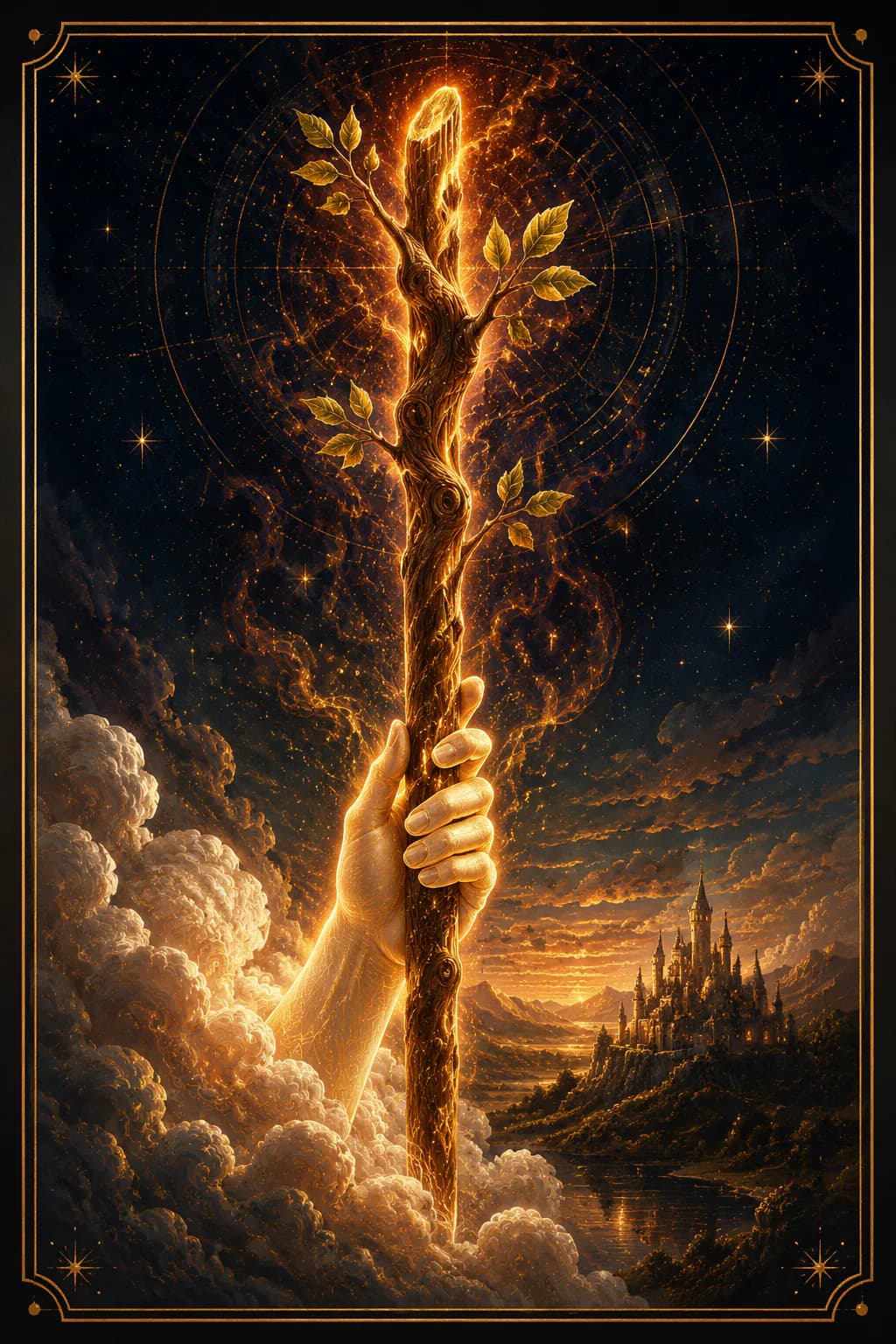
Fifty-six of the seventy-eight cards belong to a suit. Learning the suits is the highest-return thing you can do early, because the suit tells you the register a card is speaking in before you know a single thing about the card itself. Get the four right and an unfamiliar card is already half read.
Wands — fire
Drive, direction, appetite. Wands are about wanting something and moving toward it: projects, ambition, momentum, the energy you bring rather than the thing you bring it to.
What wands are not is achievement. They describe the push, not the result — a suit full of wands can perfectly well describe someone working very hard on something that is going nowhere. When wands dominate a reading, the question is usually about drive: too much of it, or none, or aimed at the wrong thing.
Wands go wrong through heat. Impatience, starting before thinking, burning something down to feel like you did something.
Cups — water
Feeling, attachment, relationship. Cups cover what matters to you and who, and the full range of it: love, grief, loyalty, disappointment, the pull toward people and the cost of it.
Cups are not automatically pleasant. The suit of feeling includes all the feelings, and some of the hardest cards in the deck are cups. Nor are cups only about romance. Friendship, family, and your relationship with your own inner life are all cups territory.
Cups go wrong through dilution. Sentiment instead of honesty, wanting the feeling of a thing rather than the thing, drifting because deciding would mean losing something.
Swords — air
Thought, language, conflict. Swords are the mind: what you think, what you say, what you tell yourself, and what happens when those disagree with each other or with someone else.
Swords have a bad reputation and it is only half deserved. Yes, the suit contains the deck's most uncomfortable images, and yes, a spread heavy in swords is usually a difficult one. But swords are also clarity, decision and the willingness to name a thing accurately — and there are situations where the kindest card in the spread is a sword, because it stops you pretending.
Swords go wrong through severance. Cutting when you could have spoken, arguing to win, thinking a problem to death instead of touching it.
Pentacles — earth
Work, money, health, the body, the slow and material. Pentacles are the suit of things that take time and leave a mark: the job, the rent, the sleep, the house, the long unglamorous accumulation of effort into something solid.
Pentacles are the least dramatic suit and often the most practical to receive. A reading full of pentacles is rarely thrilling and frequently actionable.
Pentacles go wrong through inertia. Security that has become a cage, measuring the wrong thing, staying because leaving is expensive.
The arc from ace to ten
Within each suit the numbers run roughly from a thing beginning to a thing complete.
The ace is the suit at its purest and least formed: the offer, before anything has been done with it. The middle numbers are the working-out, and they are where the difficulty usually sits — the twos through fives of any suit are the part where something is being negotiated. Six through nine are consolidation, and the ten is the suit taken all the way to its end, for better and worse. A ten is not automatically a happy ending; it is a completion, and some completions are heavy.
Reading a suit in sequence is the fastest way to learn it. Look at the deck and read the ace through ten of one suit in order, rather than reading ten cards from ten different places.
The court cards
On top of each suit sit four court cards — page, knight, queen, king — sixteen in all. They are usually read either as people in your situation, or as modes of behaviour: ways of doing the suit rather than instances of it.
A page is beginning and learning; a knight is committed and moving, sometimes too fast; a queen holds the suit inwardly and well; a king holds it outwardly, with authority. A knight of swords and a king of swords are both about thought, and they behave nothing alike.
Reading suits across a spread
Suits are most informative in aggregate.
One suit dominating tells you the register the situation is really in, and it is frequently not the register you asked in. A question about work answered almost entirely in cups is a question about the people at work.
A suit entirely absent is often more interesting. A financial question with no pentacles is not really about money. An emotional question with no cups is being handled from the head, and that may be the finding.
All four present in a small spread usually means the question is touching several parts of your life at once — worth knowing before trying to solve it in one move.
Repeated numbers across suits — two fives, three aces — say the same stage is showing up in several areas at the same time.
Readings on this site call these out directly. When one suit dominates, when one is missing entirely, when several aces or court cards appear, when a number repeats: those observations are composed into the reading alongside the card-by-card text, because they are the things any reader would notice about the shape of a spread before starting to read it.