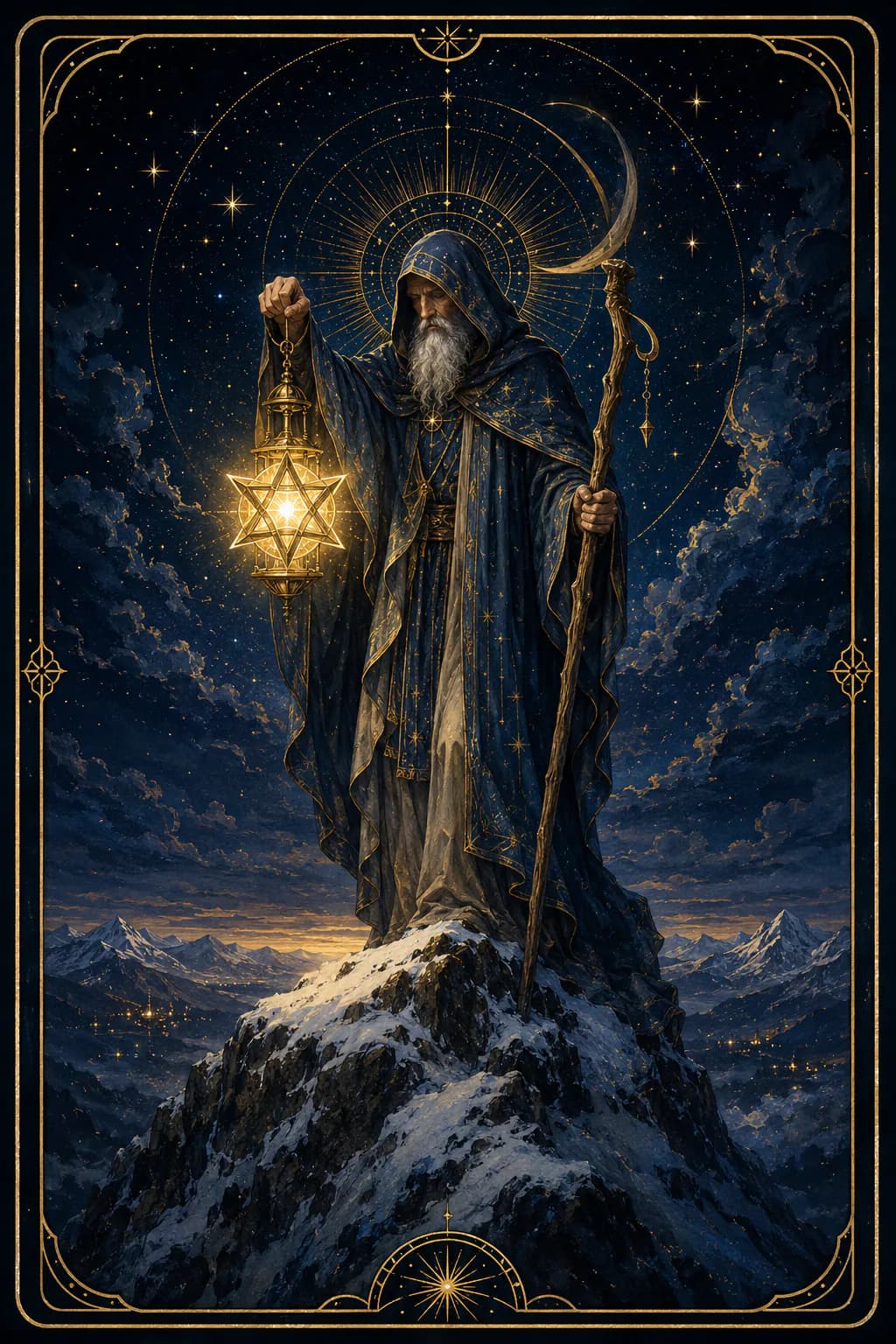

A tarot deck is 78 cards in two unequal parts: 22 Major Arcana and 56 Minor. Almost every explanation of the difference says the majors are important and the minors are everyday, which is true enough to be repeated and vague enough to be useless at the table.
Here is what the division actually does.
Scale, not importance
A Major Arcana card describes something at the scale of a chapter. Not necessarily dramatic, but structural: the kind of thing you would mention when explaining the last two years of your life to someone who had been away.
A Minor Arcana card describes something at the scale of a scene. A conversation, a week, a decision, a mood that will pass. Minors are where the specifics live.
Neither scale is more important. A chapter you cannot influence matters less to your Tuesday than a conversation you can. The difference is not weight — it is how much room the card is talking about.
Agency, and how much of it you have
This is the more useful distinction and it is rarely stated.
Minor Arcana cards tend to describe things you are doing, or could do differently. They respond to effort. When a reading is mostly minors, it is usually telling you that the situation is workable at your own scale, and the advice in it is literal advice.
Major Arcana cards tend to describe conditions you are inside of. You can meet a major well or badly, but you do not usually get to decline it. When majors dominate, the reading is generally not about what to do; it is about what is happening, and your part is how you carry it.
That is the practical use of counting majors: it tells you whether the reading is answering what should I do or what is this.
The suits, briefly
The 56 minors are four suits of fourteen, each tied to an element, and the element is the fastest way to know what a card is about before you know the card.
Wands are fire: drive, direction, wanting something and moving toward it.
Cups are water: feeling, attachment, what matters to you and who.
Swords are air: thought, language, conflict, the things you tell yourself.
Pentacles are earth: work, money, health, the body, the slow and material.
A spread where one suit crowds out the others is telling you which register the situation is really in — and it is frequently not the one you asked in. A question about a job answered almost entirely in cups is a question about a relationship at work.
Within each suit, the numbered cards run ace to ten, roughly from a thing beginning to a thing complete, and the four court cards — page, knight, queen, king — sit on top of them as people, or as ways of behaving.
Reading the mix
Count the majors before you read anything. The proportion changes what kind of reading you are holding.
No majors at all. Everything in play is at human scale. This is good news more often than it looks: nothing structural is in the way, and the situation will answer to ordinary effort. It can also mean the question was smaller than the worry attached to it.
One or two majors. The usual case. Read the majors as the frame and the minors as what is happening inside it.
Half or more majors. Something larger is going on than the question admitted. Advice-shaped cards will feel unsatisfying here, because the spread is not describing a situation that advice would fix. Read for what is happening and what it is asking of you.
All majors. Rare, and worth pausing on. Either the question was much bigger than it sounded, or it was so vague that the reading defaulted to the largest available scale.
The same logic applies to what is missing. A reading about money with no pentacles in it is answering a different question than the one you asked. An emotional question with no cups is often being answered from the head — which may be exactly the point.
What this site does with it
Readings here are composed rather than retrieved: the text is written in advance, sentence by sentence, and assembled at the moment you draw. Part of that assembly looks at the shape of the whole spread rather than the individual cards, and the major count is one of the things it looks at. So is a suit that dominates, a suit that is entirely absent, a repeated number across positions, several aces, several court cards, and how many cards came up reversed.
Those are the remarks that appear alongside the card-by-card text. They are not extra prediction. They are the observations any reader would make about the shape of the spread before starting to read it, made explicit.
Two things to stop doing
Treating a major as automatic drama. Death, the Tower and the Devil are structural cards, not disasters. A structural card in a small question usually means the question is attached to something bigger, not that something terrible is coming.
Treating minors as filler. The minors are where a reading becomes specific enough to act on. A spread of majors is impressive and often tells you less about Thursday than three pentacles would.
Where to look next
If the suits are the part you want to get fluent in, read the individual cards — every card in the deck has its upright and reversed reading laid out, and the numbered cards of a suit make much more sense read in sequence than one at a time. Start with an ace and work up.